What we do
Most of the septic work in Connecticut falls into three buckets, and we handle all three:
- New systems for new houses, and for lots that have never had a system.
- Repairs when part of an existing system fails: a broken tank baffle, a crushed pipe, a clogged distribution box, or a leaching area that no longer takes water.
- Full replacements when the leach field is done and a new tank and leaching system have to go in, often while the family is still living in the house.
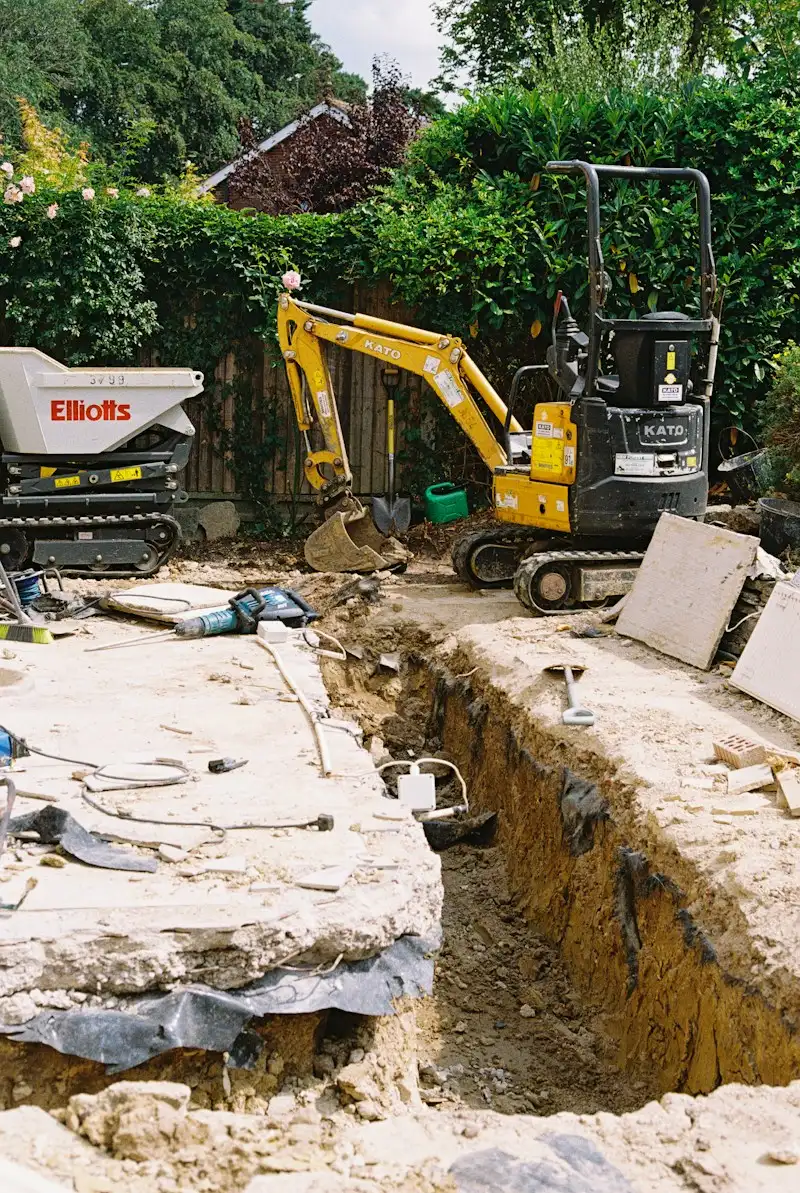
We also dig for the things that come before and around a septic job: deep test holes for soil testing, access for pumping trucks, sewer and water line trenches, and the final grading and seeding once the health department signs off.
How a septic job works in Connecticut
Septic systems here are regulated under the Connecticut Public Health Code and approved by your town's local health department or health district, not the building department. In Bristol and Burlington that is the Bristol-Burlington Health District. The steps are similar in every town:
- Site visit. We look at the house, the old system if there is one, the well, the slope, and how we'll get equipment in without wrecking the yard.
- Soil testing. Deep test pits and percolation tests are dug in the proposed primary and reserve leaching areas and witnessed by the health department. The results set the size and type of system.
- Design and approval. For new systems the plan is usually prepared by a professional engineer. The health department reviews it before anything is built.
- Permit to construct. A licensed installer pulls the permit.
- Installation and inspections. The health department inspects at set points during the job, typically before anything is backfilled.
- Permit to discharge. Once the as-built is accepted, the system is approved for use. Then we finish grading, topsoil and seed.
We walk through this in much more detail, with links to the state rules, in our guide How a new septic system gets approved in Connecticut.
Connecticut's wet season runs roughly February through May. If the health department can't confirm the maximum groundwater level during the test pits, it may require groundwater monitoring during that window, which can push a design back. If you're planning a build or a sale, get soil testing on the calendar early.
Signs your system needs attention
Call before it becomes an emergency if you notice any of these:
- Drains and toilets that are slow throughout the house, not just one fixture
- Gurgling in the pipes, or sewage smell inside or out
- Soggy ground, standing water, or unusually bright green grass over the leach field
- Sewage backing up after laundry day or a houseful of guests
Some of these are a simple fix, like a pump-out or a cleared line. Others mean the leach field is failing. Our article 7 signs your septic system is failing explains how to tell the difference and what each one usually costs you if you wait.
Why homeowners call us
- Family owned since 1976. Mike Terwilliger built this company on honest work, and his sons run it the same way.
- Our own machines and crews. No waiting on rented equipment or a sub to show up.
- We keep the yard in mind. We plan access to protect your lawn, driveway and trees where we can, and we leave the site graded and seeded.
- Straight answers. If a repair will do, we'll tell you. If it won't, we'll explain why.
Common questions
How long does a septic replacement take?
The digging and installation itself is often a matter of days. The longer part is usually before that: soil testing, the design, and health department review. Weather and inspection scheduling also play a role. We give you a realistic timeline after the site visit.
Do I need a permit to repair my septic system in Connecticut?
In most cases, yes. Installing, repairing or modifying a septic system generally requires a permit from your local health department, and the work has to be inspected. We'll tell you what your town requires before we start.
Can you work on my septic system in the winter?
Often, yes, as long as the ground can be dug and the health department can inspect. Frozen ground and snow cover can slow things down. Soil testing for new designs may be limited during the wet season if groundwater can't be confirmed.
How often should a septic tank be pumped?
The EPA says a typical household tank is pumped every three to five years and the system should be inspected at least every three years. Household size, tank size and garbage disposal use all change that.